Thursday, October 30, 2008
Left holding the baby
You never know when skills you learned years ago will be needed. At a recent leaving gathering for an employee of the Project there was a need for me to leap into the breach. Gladness's baby, Elizabeth, required holding while mother was eating. She is a beautiful baby, even when awake, and the gentleness of my holding thankfully kept her asleep. But you never loose the old skills


Wednesday, October 29, 2008
Childrens' lot seems a happy one
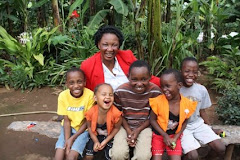
Life out here for children can be a very busy one. Once school is over and at weekends and even each morning you will see them busy doing a whole lot of chores. For some it is the daily carrying of water from the stream source to their home. For others it can be the washing of their cloths in the local stream or sweeping paths and often working in the garden watering the plants or cutting grass for their cattle. They certainly earn their keep Despite all they have to do they always pleased to see you and the greeting is always the same Good morning sir! How are you! You always go through the ritual of giving them the opportunity to see the few words that they have learned at school. You always ask them their name. And course there is lots of play - very primitive play. The sort that the more mature of us engaged in when we were children. No fancy equpment or computer games. I've seen the equivalent of hop scotch. Their balls are made out of paper tightly wrapped in string and they play football continually and what skill. The best views of them are on Sunday when they trip passed my house in their Sunday best. You wouldn't recognise them.
Monday, October 27, 2008
Visit to Dar es Salaam
Two weeks ago I travelled to Dar es Salaam, the capital of Tanzania to obtain a certificate of exemption which would allow me to work in Tanzania for the coming year. I flew to Dar' on the way out and travelled back by coach to enable me to see a little more of the countryside. The flight out was spectacular because I managed to take a photograph of Kilimanjaro majestically rising above the clouds and the cloud formations were also special.
I had to pick up my permit from the Ministry of Immigration but involved journeys to Ministry of Education and Internal affairs before I finally received the permit. It was touch and go if we would receive it before out departure. But the Immigration official took pity on us when we said we were traveling back to Maragangu Mtoni the next day and we got it at the end of the day.
I didn't see much of Dar' it was a typical large city and the major port for imports into Africa. But visited some nice restaurants and had cocktails at the KIlimanjaro hotel overlooking the harbour. But my interesting two days were not over!! The bus ride back to Marangu Toni should have taken 8 hours but it took twelve hours because there was a crash on a one way bridge and we were held up in a 2 hour stand off with no traffic moving and nobody willing to give way. There was a police station on the bridge but they stayed inside until it was sorted by a member of the public. The bus driver then drove continually for 6 hours trying to make up time with only a 20 minute stop. I was on the front seat and had my eyes glued to him looking for any signs of tiredness. I noted that he drank a can of Red Bull. I was delighted to get off the bus and return to the slowly slowly of my village. A trip to remember
Wednesday, October 22, 2008
The Dala Dala
To visit the nearest town Moshi which is 40 miles away. You first have to walk down to the Marangu Mtoni village about 40 minutes walk and there you pick up the local bus service. When I say local bus service it doesn't run to a timetable that has any sense or meaning. There are either 5 there or none. Mind you those of us who now have a bus pass would say ever the same! The service is run my individuals who own a mini bus. They are usually beat up old vehicles that have been modified to increase the number of passengers from 13 to 20. Two Saturday's ago I travelled to Moshi for shopping. I was fortunate to be one of the first person on the bus as so I had a pick of seats I opted for one half way down the bus. By the time the bus left it had 18 people on board. The bus can be flagged down at any point on the journey. Before we had travelled 5 miles there was 23 on the bus with 5 people standing including the conductor who seemed to get much pleasure from hanging out of the bus the whole journey. It is certainly a way to get to know the local people. They only drive at two speeds either flat out or stop. On my return journey I was not so fortunate as there was limited choice of seats. I ended up on the back seat which should have seated 4 people but which had 8 and a baby. The baby for some reason cried every time I looked at her?! I did consider asking to see the drivers MOT and insurance certificate before I got on but thought better of it. They are certainly dangerous and surprise surprise we passed one in a ditch on the way home. Happy days
Monday, October 20, 2008
A woman's work is never done
On all my walks in the surrounding woods and forest and on the parthways down to Marangu Village I have never seen a man carrying anything. It is the women who seem to do the fetching and carrying. So walking up from the village after market day it is the women you see carrying the shopping. It might be sacks of grain or heavy water containers and the other day I met one carrying a grate of Kilimanjaro beers. Their work outside shopping is also very demanding as you often see them cutting grass for their cattle but also collecting firewood to enable them to do their cooking. These pictures where taken when I walked up into the forest above where I live. Gathering firewood is illegal from the forest but there were many mums and daughters carrying these heavy loads on their heads. It really is a man's world here
Friday, October 17, 2008
The Chagga Cave -Kasimo Cave
Recently I had an opportunity to visit some local caves in the foothills of Kilimanjaro. All I was told was that these caves were interesting and worth seeing. I imagined some ancient rock formations and an opportunity to see cave drawings. Little did I know the surprise that was in store for me. We were met by the Director of the Kasimo Cave Ombaeli Makuni who agreed to give us a personal tour. The first picture shows the Director at the entrance to the cave. It might look like a Chagga hut, for those of us that are more with familiar with the local culture, but it is in fact a disguised entrance to the cave. It was when we were shown inside that my pulse began to race, a little, as I looked into the hole in the ground and the homemade ladder that disappeared into the darkness. Too late to turn back. It was just a pity I had my white t shirt on and nice clean trousers. The Director produced a torch as he disappeared into the hole. Tim (another volunteer) followed and almost fell into the hole as it was very slippy as you stepped onto the ladder. I reluctantly followed as they disappeared into the darkness - only one dim torch. We crawled on hands and knees until we came to an opening where we could sit upright. The Director then began to give us the history of the caves. By the way, by my definition they were not caves but tunnels dug into the ground and also ,by the way, unsupported tunnels! Heart beating fast!! They were dug in the 1800s when the Chagger tribe were at war with the Masi tribe and used as a hidding place when the fierce Masi warriors were raiding. The clearing we had crawled into was the guard warriors hiding place and if the Masi found the cave they could be easily killed as they came through the entrance, as they had to crawl to get in, and their bodies stored on shelves!!! in this opening. We crawled in deeper to find cooking areas and sleeping areas and were told that even cattle were brought down. They would stay down here for days. There were ventilation shafts and sleeping areas. In the darkness I thought I felt something brush against me and I suddenly had this panic feeling and desire to get out as quickly as possible. Some rodent perhaps? I waited patiently for the return journey and hoped the Director knew his way out as I was at the back and there was just blackness. I was delighted to break out into the sunshine and I wasn't scared at all!? Another Tanzanian experience.
Sunday, October 12, 2008
Standard 7 Leaving Day Masia Marangu
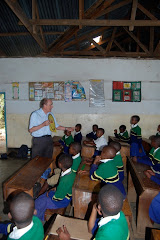
In September each year Standard 7 pupils take their National Exam over several days for entry into secondary education. After the examinations primary education is then finished. In Tanzania Primary Education starts at 7 and continues to the age of 14. There is also pre-primary education in most schools but in some the parents have to pay for the teacher. The Standard 7 examination takes place so that the top 50% of pupils can then go onto secondary education. The remainder of the pupils who are not in the top 50% then either go to vocational school or private schools which again parents have to pay for. I was privileged to be in Masia Marangu on the day of their Standard 7 leaving celebration and to be part of this. The whole school gathered on the grassed areas in front of top table. The leaving children danced and sang songs and read out poems that they had written and then they presented the school staff with a letter of thanks for all their efforts. There were prizes for the head boy and girl and they presented a gift to the staff that was passed through the hands of those assembled there before arriving with the headteacher. They all gathered for a formal photography which I took and then they ate hot food prepared, by parents and school cook, on open fires with staff and pupils together. It was all very moving and a moment to be remembered. I certainly will remember. The next day I presented a collection of all the photographs taken to the pupils.
Subscribe to:
Posts (Atom)